


Written by Thomas Opsomer, iFixit’s EU policy spokesperson.
Mandatory repair information for smartphones
Since June 20th, 2025, smartphones and tablets sold in the EU are subject to repairability requirements1. These also include a mandatory repairability score and an obligation to publish repair information.
The repairability score is self-reported by manufacturers and rates the ease of repair on a scale from A to E. It is one of five additional pieces of information depicted along with the energy efficiency on the mandatory energy label, but it is not visible on the smaller version of the label that you’d see next to a product in a webstore. A future version of the label could potentially make repairability stand out more2.
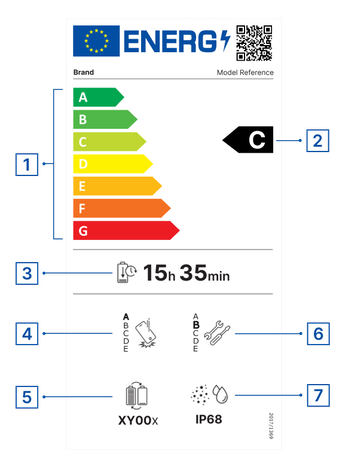
Example of the energy label for smartphones. Item 6 is the repairability score. See https://energy-efficient-products.ec.europa.eu/product-list/smartphones-and-tablets_en. In the case of online sales, the label can be accessible via a pictogram that only shows the energy efficiency.
Manufacturers and importers are also required to provide repair instructions and prices for spare parts on a free access website. EU policymakers considered the latter sufficient to enable consumers to take parts prices into account in their purchasing decisions, rather than following the French example of including spare parts prices in the repair score, as the Right to Repair campaign repeatedly recommended3.
One year in, 4 out of 5 smartphones don’t meet the requirements
One year after these requirements became applicable, we decided to check how well they are respected by reviewing the European Product Registry for Energy Labelling, where manufacturers and importers are required to list the websites where they publish the required information4.
The results are abysmal. Out of 2334 records of smartphone models placed on the market over the last year, only about 18% actually list websites where spare parts prices or repair instructions can be readily found. Almost exactly half of the records simply have blanks where the URLs should be. Another 19% refer to a product page or support page where there are neither repair instructions nor spare parts prices to be found. Ridiculous price brackets such as 14-128€ for a battery also fall into this category.
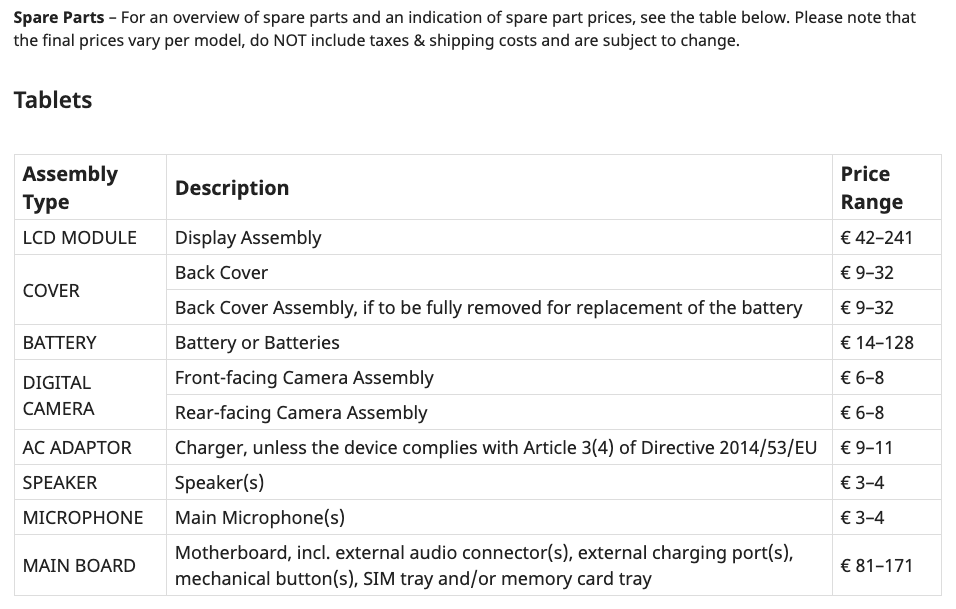
This is Acer’s interpretation of ‘‘indicative prices’ for spare parts. A new battery for your tablet would cost somewhere in the range of 14 to 128€… But don’t pin them down on this precise bracket, as the final prices are subject to change of course. See https://www.acer.com/gb-en/support/Repairability.
Another 8% offer a useless reference such as ‘see manual’ and close to 5% simply refer to Temu or AliExpress5 – not just for spare parts prices but even for repair instructions.
Egregiously, some of these blatantly non-compliant manufacturers still award themselves a perfect score for repair information6 resulting in a self-declared class A for repairabililty.
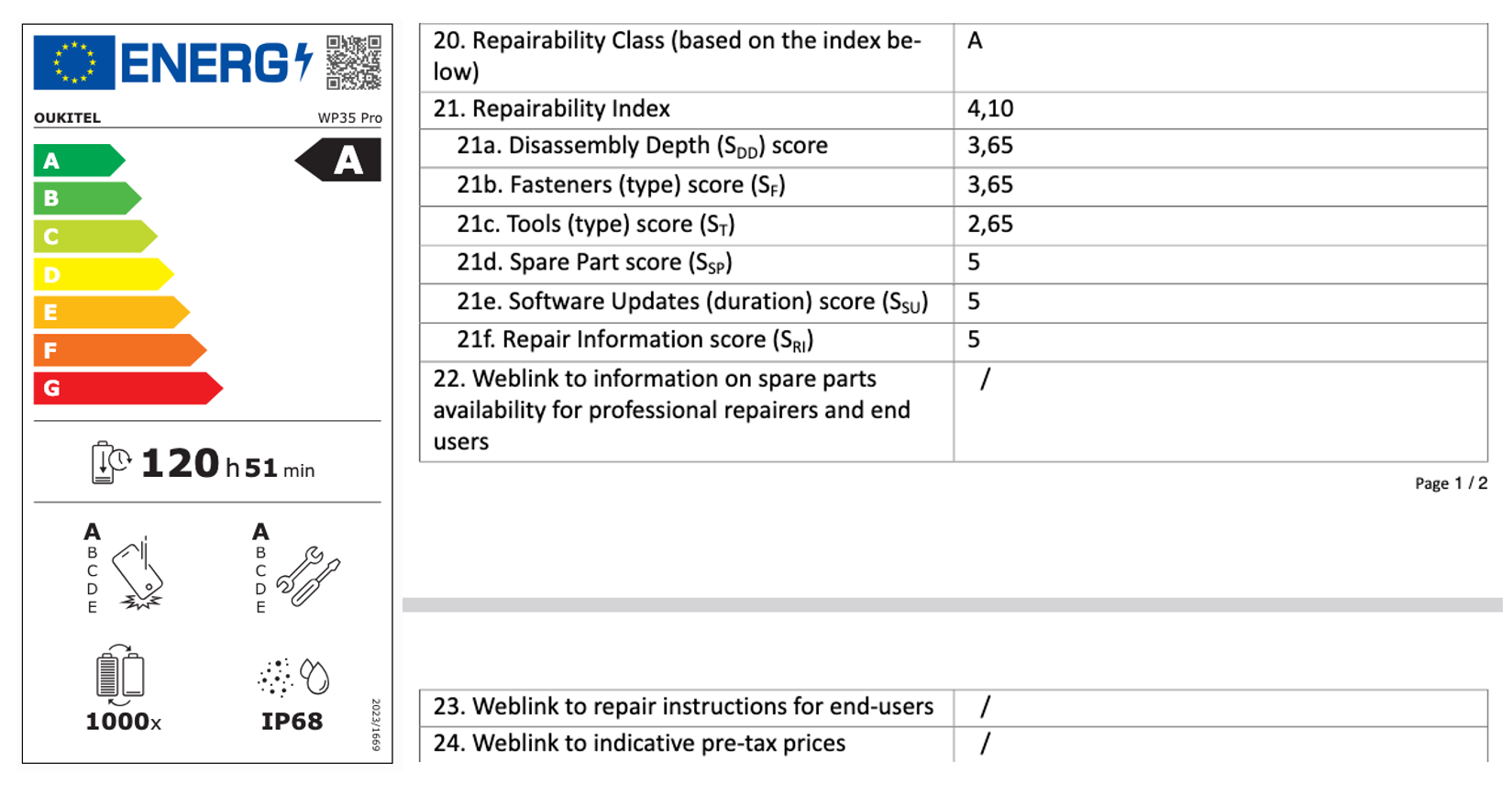
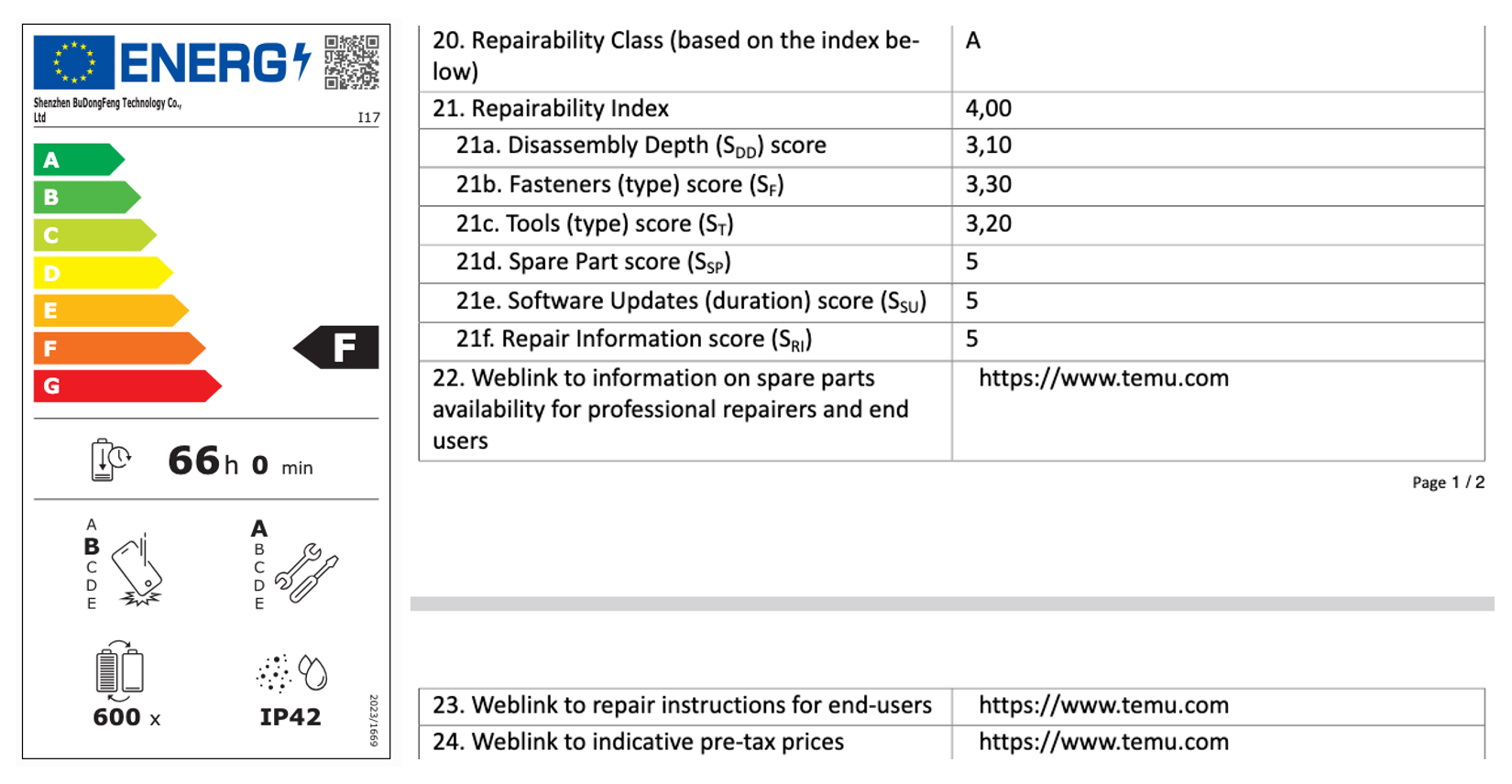
Screenshots of the energy label and information sheet for an Oukitel WP35 Pro smartphone and a Shenzen I17 tablet currently on the market, both listing a class A repair score that is based on a perfect score for spare parts availability and repair information – but leaving the relevant fields completely empty or referring the user to Temu for spare parts or repair instructions. See https://eprel.ec.europa.eu/fiches/smartphonestablets20231669/Fiche_2356954_EN.pdf, https://eprel.ec.europa.eu/fiches/smartphonestablets20231669/Fiche_2651432_EN.pdf.
How is this possible?
Faced with these numbers, one has to stop and question the effectiveness of the current approach. How is it possible for such glaring non-compliance to exist? And how can we be confident that self-declared repair scores are more than mere greenwashing?
A blank where a URL should be is not hard to spot – in fact it could even be automatically detected – yet thousands of blank fields seem to have gone unnoticed. Clearly, no public authority has taken it upon themselves to check the declared data. The verification of compliance falls upon the individual member states, who don’t have the staff to conduct extensive checks – especially for such ‘minor’ cases of non-conformity which don’t put the lives of consumers at risk. De facto, they seem to be largely counting on consumer organisations and other NGOs to do the patrolling for them – as we did in this case.
Compliant doesn’t mean easy to find.
It should be noted that even for products that are technically compliant, the listed weblink still rarely offers a straight path to parts prices. For major brands such as Apple and Samsung, it takes some more clicking and selecting before you get there7. One can question how many consumers would do all of the necessary navigating in order to take spare parts prices into account when deciding which smartphone to buy. Arguably, integrating parts prices into the repairability score would work much better to encourage competition in this field.
This is just the tip of the iceberg
Missing information in EPREL sheets is only part of the problem. Obviously, when the required information is not made available by the manufacturer or importer to begin with, the non-compliance will affect all sales channels. However, even when the information is available from the manufacturer, it doesn’t necessarily mean that it will be shown to the consumer. In fact, we found the energy label as a whole to be missing for a significant number of products offered for sale both in physical stores and online8.
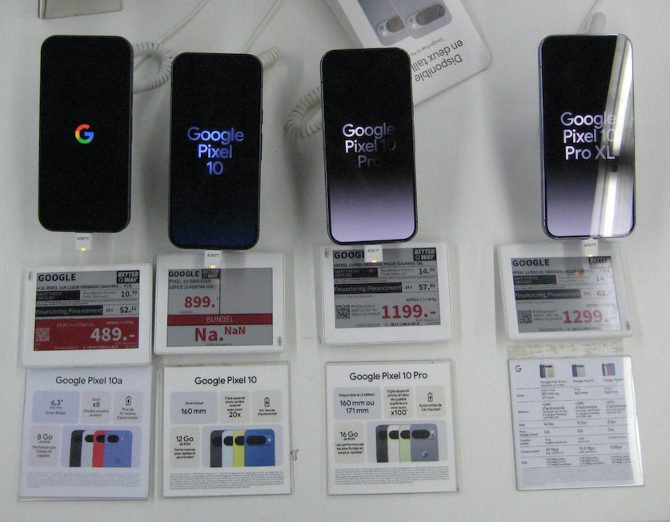
Smartphones offered for sale at Mediamarkt in Brussels, with no energy label and hence no repair score. Picture taken on May 12th, 2026.
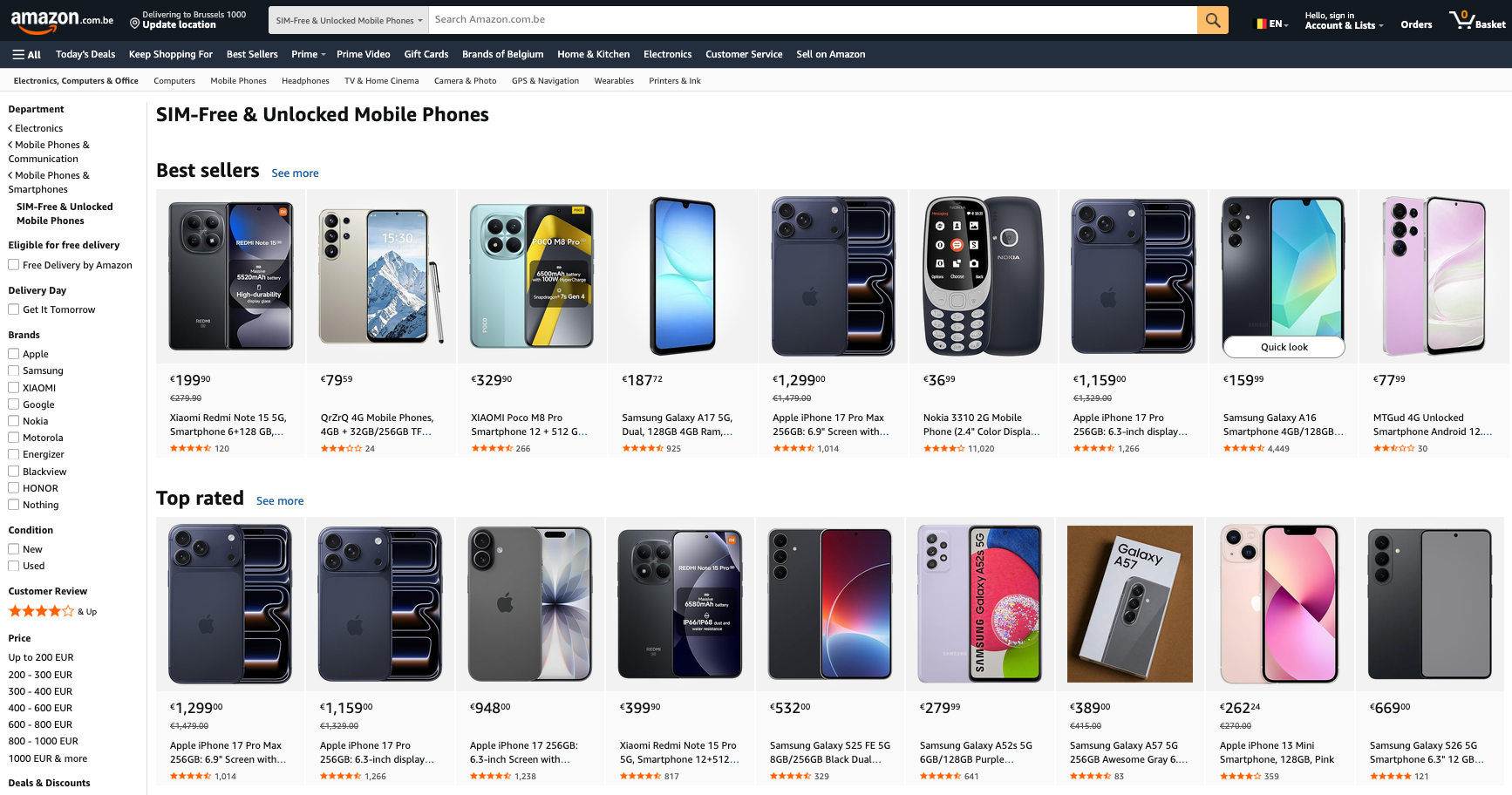
Best selling phones on amazon.com.be, with no energy label and hence no repair score to be seen. Screenshot taken on August 27th, 2026.
The issue of non-compliance isn’t limited to smartphones either. We also did a check for tumble dryers, for which similar requirements apply from July 2025 onwards, and again found over half of the models to be non-compliant9. For many compliant models, the clicking odyssey was even more complicated than for smartphones10.
Finally, consumers aren’t the only victims of a lack of information. Professional repairers can also have trouble accessing the repair information that they are legally entitled to – something we’ll cover in an upcoming blog post.
Transparency and market surveillance
How can all this be solved? Clearly, market surveillance authorities need to invest more resources to check conformity. As it is, they seem to be counting on consumers and NGOs to do the monitoring for them. While one can debate whether it’s fair for public authorities to implicitly outsource this work without providing funding for it, for this to work at all would require a more transparent system and easier reporting of non-compliance.
While the EPREL website provides a link for reporting non-compliant products, this has not been publicised at all. Contrast this to the dedicated platform for users and repairers to signal non-conformity with the French indice de réparabilité. It is also unclear what right to redress a consumer would have if a supposedly repair-friendly product turns out to be unrepairable when it breaks down. But mostly, in its current form, the EU repairability score is partially based on data that the general public cannot check, as there is no obligation to publish the full calculation on which the score is based.
Measuring the energy efficiency of an appliance is complicated, but most of the repairability requirements are fairly easily verifiable given sufficient transparency. A requirement for manufacturers and importers to declare the full report underpinning declared repairability scores, coupled with an EU-wide platform for signalling non-conformity, would go a long way in enabling consumers, repairers and NGO’s to help market surveillance authorities in making sure that the rules are upheld by all.
This blog post is a brief summary of a review by iFixit and Right to Repair Europe of over 7000 EPREL records as well as sales channel spot checks. We would be happy to share more detailed findings with market surveillance authorities, consumer organisations and journalists. Don’t hesitate to reach out via info@repair.eu.
References
- You’ll find an overview of current EU repair laws on our What’s my Right to Repair page.
↩︎ - See https://www.eco-wise.co.uk/blog/a-sneak-preview-of-the-ecodesign-label-for-textiles-furniture-mattresses. ↩︎
- See https://repair.eu/?s=price. ↩︎
- See https://eprel.ec.europa.eu/screen/home. ↩︎
- Sometimes, this situation is slyly camouflaged: Ulefone information sheets list a link that looks genuine (https://www.ulefone.com/pages/support-centers), but if you click the ‘parts store button’ on that page, it takes you to Aliexpress. When ordering parts from non-EU web stores, you as a consumer would be the importer and as such, responsible for paying import duties as well as ensuring compliance with all regulations.
↩︎ - A 5/5 score for the subcriterion on repair information, as self-reported by the manufacturer, corresponds to ‘Public availability of repair and maintenance information, except electronic board diagrams, at no cost for end users and availability of repair and maintenance information, including electronic board diagrams, at no cost for professional repairers’.
↩︎ - The link in the EPREL sheet should lead “to the website where the relevant information will be available”. So far, we haven’t received and answer to our question to the European Commission as to what that specifically means in terms of ease of access.
↩︎ - On mediamarkt.de, we found that about 30% of smartphones offered for sale (690 out of 1671 products) did not come with the mandatory ecolabel that includes the repairability score. In Mediamarkt’s physical store in Brussels, we found the energy label to be missing for one out of six smartphones (19 out of 113 displayed in the store). In smaller shops, the label was totally absent. On online platforms such as Amazon, the presence of the labels was also hit-or-miss. ↩︎
- We found only 2% of information sheets for dryers (96 out of 5159) to have empty or broken links. However, the EPREL sheets for nearly 27% of appliances (1389 records) from major brands point to pages that require login, entering the serial number of the appliance, or contacting support via email, phone or an online form and another 26% of models (1317 records) point to a general brand or support website, which will be of no help at all to you in your search for spare parts prices or repair instructions. All in all, we found that for 55% of models, the information sheet doesn’t actually lead, as per the regulation, “to the website where the relevant information will be available”.
↩︎ - For Smeg dryers, you first have to choose your country, click that you want to order parts, indicate whether you’re a consumer or a professional, confirm that you know which parts you want, choose your country again, enter the model number, and finally click on a button to confirm that the price list is indeed what you’re after. Phew. Good luck deciding which dryer to buy on that basis.
↩︎

It would be great if these repairability requirements were also extended to smartwatches, particularly premium sports smartwatches.
A €600–€1,000 smartwatch can cost as much as, or even more than, many smartphones, yet it can be left completely outside the repairability framework. This means that an otherwise perfectly functional device may end up as electronic waste simply because of a small mechanical failure, such as a single broken button.
It seems rather absurd that a €600 smartphone can benefit from repairability requirements, while a €1,000 sports smartwatch can effectively be considered disposable.
If the EU is serious about reducing electronic waste and extending the lifetime of products, smartwatches should not be the forgotten category.