


Written by Thomas Opsomer, iFixit’s EU policy spokesperson.
We recently reported on the hit-or-miss availability of repair-related information that consumers are entitled to in our blog post “One Year Into EU Ecodesign Rules, 80% of Smartphones Still Lack Required Repair Information”. While you may have a hard time accessing repair information as a consumer, professional repairers also run into issues.
Access to information is getting worse, not better
Jacob D’Hollander has been repairing household appliances since 2010 in the Belgian town of Ghent. He ticks all of the boxes for a right to repair information under Ecodesign1: proven competence, VAT registration, insurance – but he still struggles to get access to the necessary repair information. «The new regulations have not made it any easier for me to get service manuals or error codes,» says Jacob, «in fact, over the last few years, it has gotten worse. Manufacturers are now overly cautious with sharing information. I suspect that the race towards AI-based repair solutions makes them more paranoid than ever.»
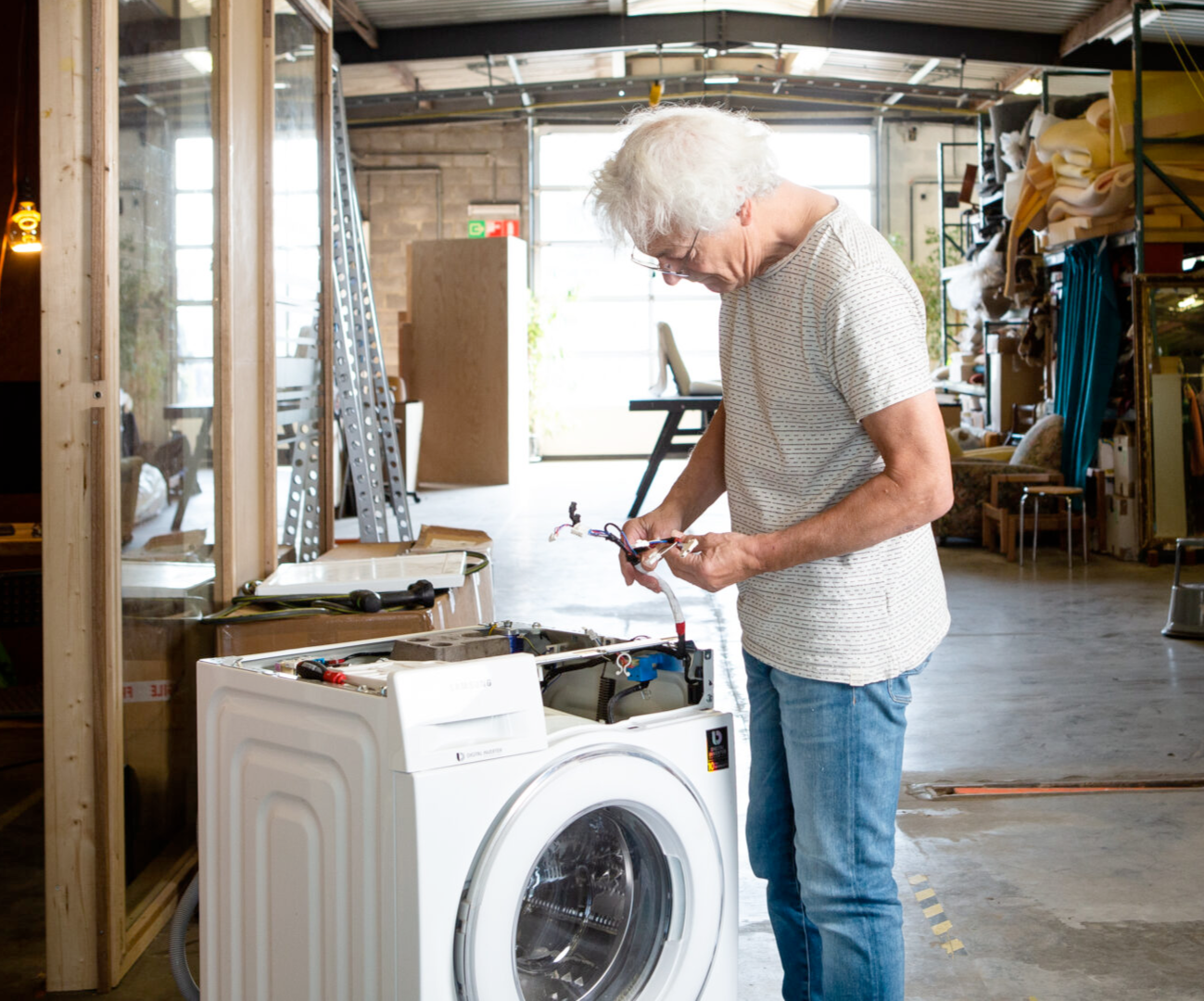
Jacob repairing a washing machine a few years ago, when repair information was still easy to come by. Photo © Brecht Van Maele
«I used to just call a guy at the service department and he would send me the documents I needed, no red tape. Now they tell me they are not at liberty to disclose the information«.
Blatant refusals and empty promises
Since last autumn, Jacob has been sending e-mails to all of the major brands of household appliances: AEG, Bauknecht, Bosch, Beko, Electrolux, Indesit, Miele, Neff, Siemens, Whirlpool, Zanussi,… While Ecodesign regulations are supposed to guarantee him access to repair information within 5 working days, he is still standing mostly empty-handed after eight months of repeated requests. Only the Beko group (with brands such as Bauknecht and Whirlpool) has provided him with the information that he has a legal right to obtain.
In January, he got a reply from the Head of Customer Care for one of the brands he contacted, providing him with the following ‘clear and definitive explanation’: «Our in-depth repair methods, wiring diagrams and diagnostic test programmes are proprietary information. Access to this information is restricted to our authorised service partners who have a contractual agreement with [brand name], undergo specific training and use tools validated by us. This policy ensures the safety and quality of repairs and the correct handling of our technology.» (see picture)
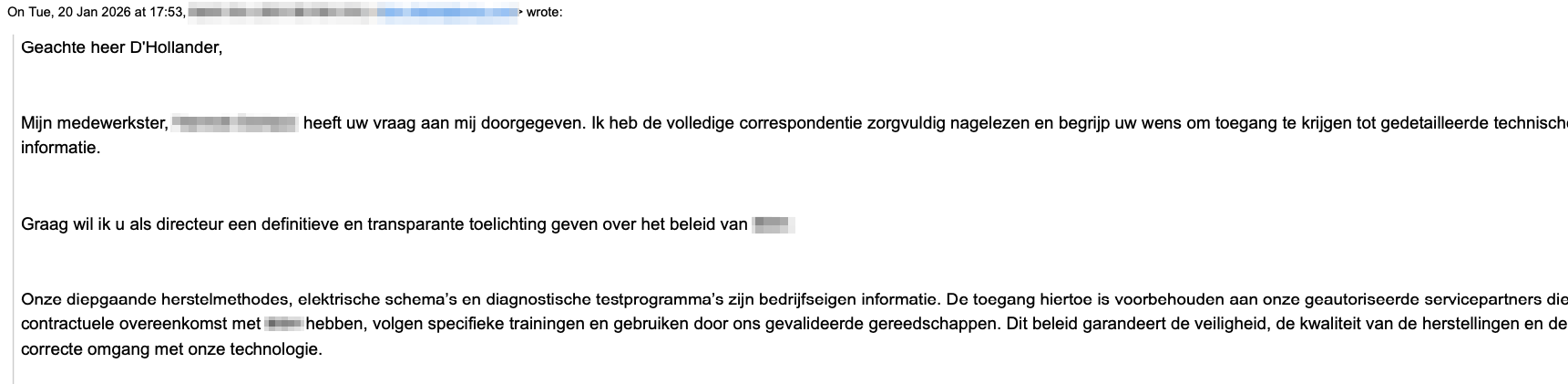
E-mail from the Head of Customer Care of a leading brand, with a ‘clear and definitive explanation’ of their refusal to provide the necessary repair information
This is quite the statement for a person in that position, given how blatantly it contradicts the legal requirements. These ensure access for professional repairers to all necessary information, explicitly including diagnosis information and wiring and connection diagrams2.
When members of the Right to Repair Europe campaign brought this to the attention of the manufacturer’s Environmental Governmental Affairs person in Brussels, they were told that this was a misunderstanding, that internal clarifications had been necessary, but that this was now resolved. Indeed, the Head of Customer Care reached back out to Jacob with apologies and promises to ensure speedy access.
That was back in February. Six months later, that access still hasn’t materialised. Another major brand similarly made promises many months ago that never came true. Right to repair still loading… ⏳
Other brands have actually granted Jacob access to their spare parts sales platform Tradeplace, however the tab with service information that should be there (Jacob has seen it in screenshots) is missing in his account. Apparently they are fine with selling parts to him, not so much with sharing information.
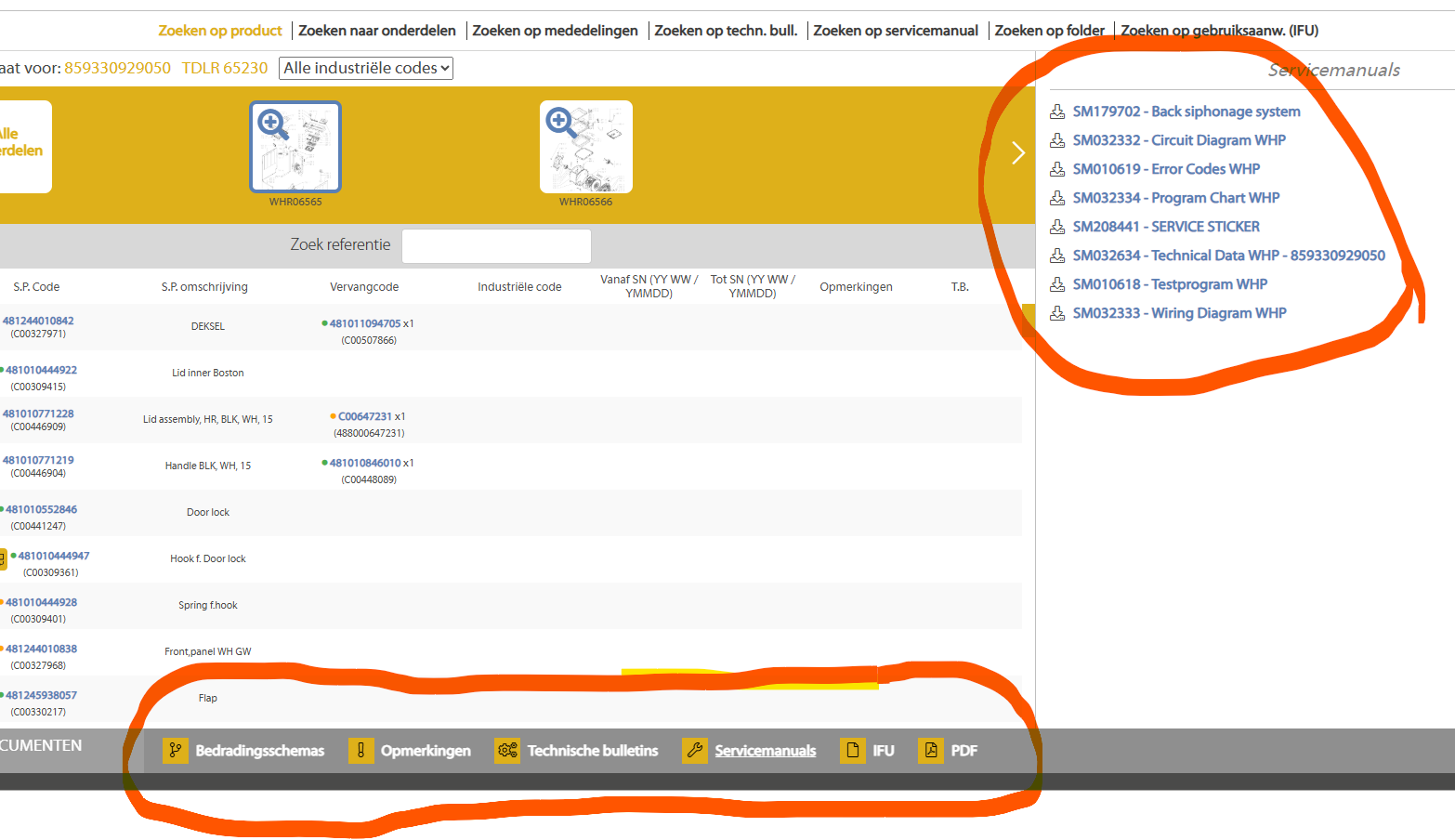
Screenshot of Tradeplace, a platform used by many brands for distributing spare parts. This version also includes a tab with repair information – which is absent in the version that Jacob received access to.
Is it a conspiracy?
So far, only a single brand has met their legal obligations. Are the others all intentionally sabotaging independent repairers?
Jacob sighs. “I don’t necessarily think this is a conspiracy… There are just many internal hurdles now, employees have simply become scared of sharing information.”
What to do about this?
Small repairers like Jacob feel powerless against huge manufacturers who treat them with total indifference. As a Right to Repair coalition, we get e-mails on a weekly basis by desperate repairers and citizens who feel their right to repair isn’t being honoured. These people need a simple way to report their complaints to the competent authorities.
The French platform for users and repairers to signal non-conformity with the indice de réparabilité is a great example. As we’ve said before, an EU-wide platform for signalling non-conformity with right to repair rules, would go a long way in enabling consumers, repairers and NGO’s to help market surveillance authorities in making sure that the rules are upheld by all. That is, provided that valid complaints result in penalties that are ‘effective, proportionate and dissuasive’ —as defined in the Ecodesign Framework regulations.
This blog post is a very brief summary of Jacob’s attempt to get the necessary information. We would be happy to share more details with market surveillance authorities in the hope that they would ensure he gets the information he is entitled to. Don’t hesitate to reach out via info@repair.eu.
If you’re a professional repairer who is facing difficulties in finding repair information, we have prepared a form for you to share your experience. You can find the form here. Your responses, including your name, will be kept confidential and will not be shared with third parties. We may report the total number of repairers who experienced this issue, but this information will be presented only in aggregate and will not identify you.
- Under various ecodesign regulations, manufacturers are required to provide professional repairers with repair and maintenance information. For instance for washing machines, the requirement has been applicable from March 2021 for any machine that has been on the market for at least two years. Manufacturers are allowed to ask repairers to demonstrate competence, insurance and compliance with applicable regulations (Regulation (EU) 2019/2023, §8.1.3.). ↩︎
- See (EU) 2019/2023 for washing machines, (EU) 2019/2022 for dishwashers, (EU) 2023/2533 for dryers and (EU) 2019/2019 for refrigerators. All of these require manufacturers, importers or authorised representatives to provide the necessary information to any professional repairer who has the required technical competence, complies with local regulations and has liability insurance. They must accept or refuse a professional repairer’s registration within 5 working days and provide the requested repair and maintenance information within one working day after the repairer requests it.
↩︎


If it is a legal requirement, why not sue?
A have a personal experience that I would like to share, last year the thermostat of my fridge broke. Instead of going on amazon to order a new one, I went to the official brand repairshop and ordered it. 3 weeks later I got the spare part and it was the wrong one. While waiting for my credit note, I ordered the part via amazon and had it the next day. I have some background in electromechanics and I usually find good tutorials on how to on youtube, this is my work around to retaining information.
Here I think that some form of Adversarial Interoperability needs to be legalized. Article 6 of the EUCD (2001) prohibits independent repair people to circumvent digital locks. So if someone found a way to access the software, or share the information, it is still considered a crime in EU law. We should not wait until we get permission from the manufacturer to be able to repair or modify their products.