

The Directive on common rules promoting the repair of goods, or as we like to call it, the Right to Repair Directive, was our big win in 2024. As summer approaches, Member States are working on the transposition into national law by 31 July 2026. We are closely following developments across Europe as the way Member States interpret and apply the Directive will determine whether it delivers real change for consumers and repairers.
Below is an interview with Katrin, from Runder Tisch Reparatur, one of our Steering Group members, about the transposition process in Germany and what is at stake.
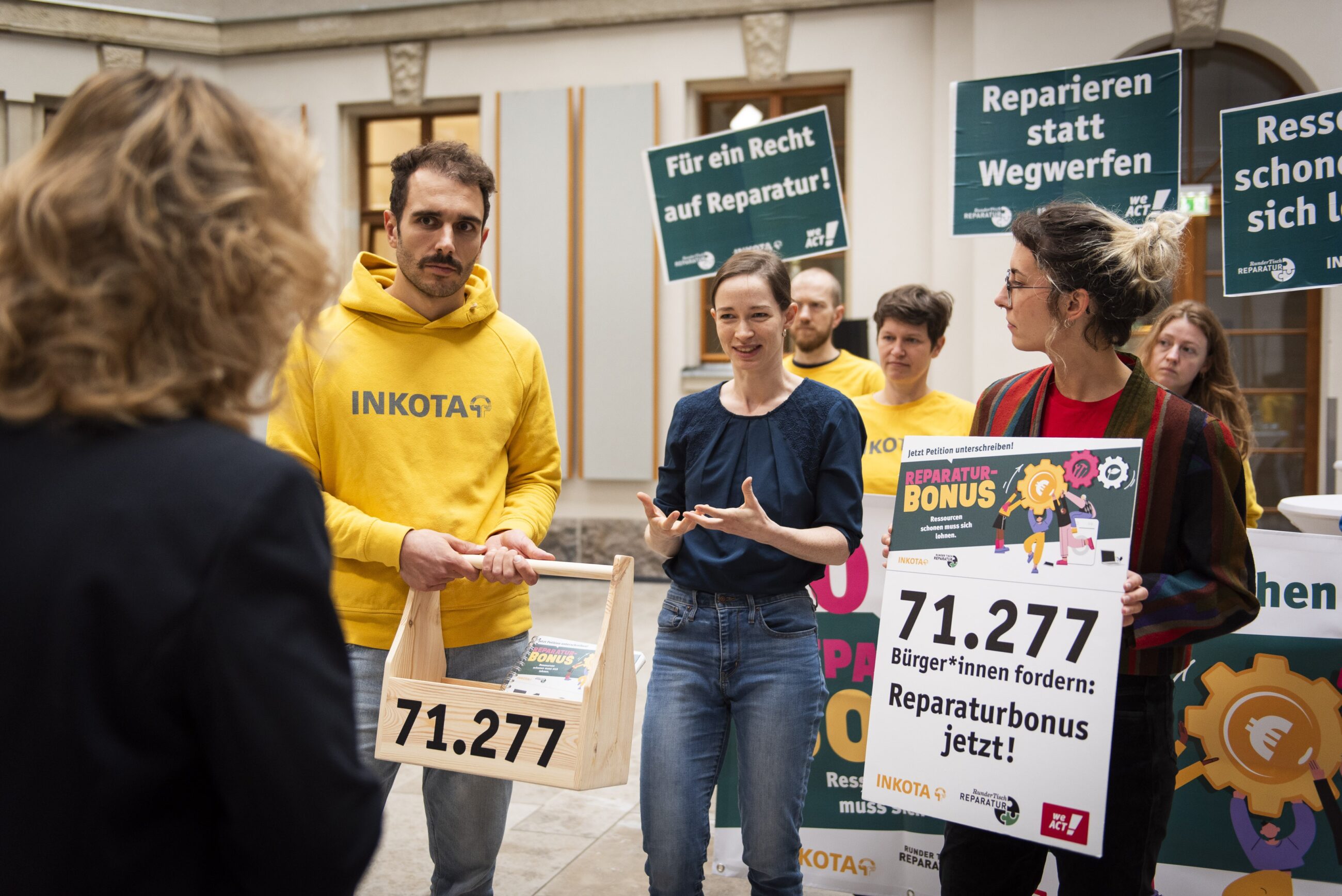
Katrin handing over a petition for a German repair fund to the then-environment minister Steffi Lemke in October 2023. Credits: Chris Grodotzki / Campact
Interview
Hello Katrin, can you tell us a bit about what Runder Tisch Reparatur is and what you do?
Runder Tisch Reparatur, or Repair Round Table, is a network that brings together a wide range of stakeholders: civil society organisations, repair communities, commercial repair businesses, scientists, and other actors who are working toward a true right to repair.
The network was founded in 2015 because we saw there was a clear need for stronger advocacy for repair and for the people who want to repair their products. Our goal is to make people aware of the potential of repair, highlight the obstacles that still exist, and identify what needs to happen to make repair more accessible and affordable again. We bring the voices of repairers into political processes and policy discussions.
Can you explain what is happening in Germany right now with the transposition of the Directive?
In Germany, the ministry responsible for transposing the Directive is the Ministry of Justice and Consumer Protection. They published the first draft of the transposition law in January, and during the consultation period we, along with other stakeholders, submitted feedback.
Since then, the government has worked on a revised draft, which is somewhat improved from our perspective. The next step will be parliamentary discussions, which are going to take place in June. The law will likely be adopted by the end of June or the beginning of July.
At this stage, everything suggests that Germany will meet the July 2026 deadline. Of course, that assumes nothing unexpected happens, but overall the process seems to be moving forward on schedule.
How much room do Member States actually have when transposing this Directive?
In general, this Directive is largely harmonised, so Member States do not have a lot of room for major deviations or alternative approaches. The requirements are quite clearly defined at EU level.
That said, there is still some flexibility in how the wording is interpreted and how certain concepts are applied in practice. These choices might seem technical, but they can have significant consequences for how repair works in reality.
Which parts of the Directive are most relevant for you?
Our main focus is on what happens after the guarantee period ends, because that is where repair becomes most challenging. During the guarantee period, repairs are often covered by the seller or manufacturer. But once the guarantee ends, consumers frequently face high costs or limited repair options. This is why access to spare parts at fair prices becomes essential. Without affordable spare parts, repair is simply not realistic.
Another positive element in the Directive is the extension of the guarantee period by one year after a repair. That creates an incentive to repair instead of replacing products.
But for us, the most important issue is maintaining fair competition in the repair market. Independent repairers must be able to carry out repairs using original spare parts, as well as second-hand or compatible parts. Manufacturers should not be allowed to block independent repairs through software or hardware restrictions.
This principle is included in the German legal text. However, there is still a question mark around exceptions related to intellectual property rights. That could potentially become a loophole, depending on how manufacturers interpret it and how authorities enforce the rules.
At this stage, there is little that can be done to fully resolve this uncertainty during transposition. Much will depend on how the rules are applied in practice.
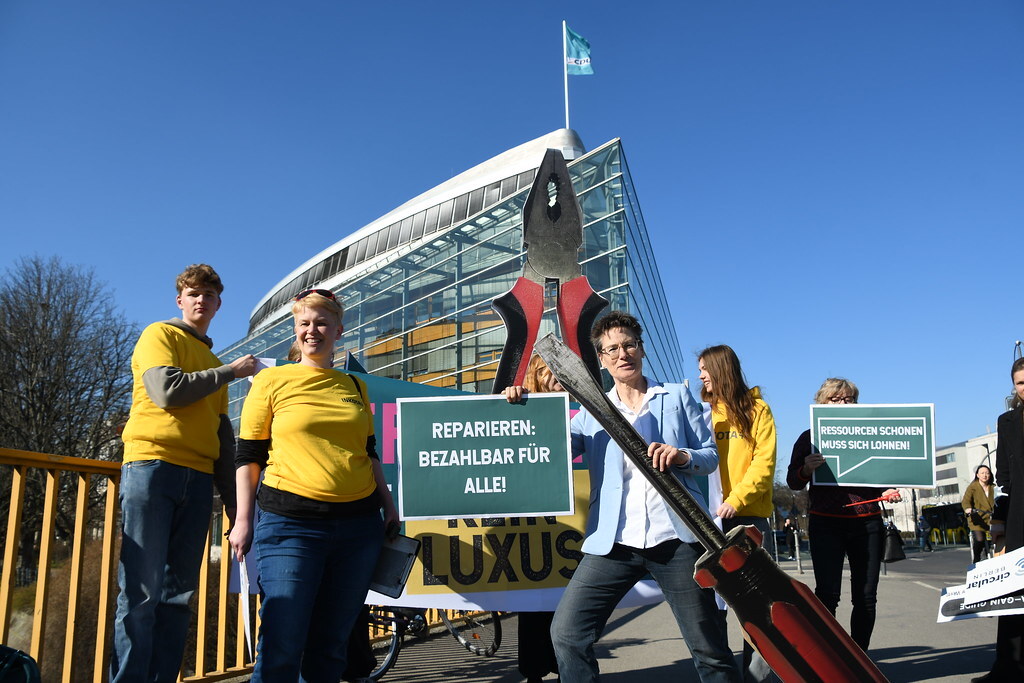
Protests for affordable repairs during formation of the new government in Germany (Koalitionsverhandlungen) in April 2025. Credits: Andrea Lauss / INKOTA
What was the issue with reasonable spare-part prices?
The Directive requires manufacturers to make spare parts available at reasonable prices that do not deter repair. This wording is now included in the German draft law.
In the first draft, however, only the phrase “reasonable spare parts prices” was included, without the important clarification that prices should not deter repair as stated in the European Directive. We strongly criticised this omission and finally, in the revised draft, the wording was aligned with the Directive.
However, the law still does not define what “reasonable” means in practice. We argued that there should be further clarification, at least in the explanatory notes if not in the legal text itself. Our concern is that “reasonable” should not be interpreted as reasonable for manufacturers, but reasonable for consumers.
Definitely, as studies show that most consumers will only consider a repair if the total cost of the repair is less than 30% of the cost of the new product. Did you include this in your feedback?
Yes, we suggested commissioning a public authority to provide a clarification on this point, taking into account the findings regarding these threshold values We quoted the evidence we presented as a coalition back in 2024 showing this.
Without more concrete benchmarks, enforcement will be difficult. It will be hard to determine whether manufacturers are complying with the requirement to offer spare parts at reasonable prices.
Another relevant point is the national repair promotion measure, do you know what that will be in Germany?
Not yet, as it does not need to be included in the transposition law and member states have until July 2029 to communicate it to the Commission. The government introduced a repair promotion programme in 2024 that provided financial support to repair initiatives. Repair cafés and similar initiatives could receive grants of up to 3,000 euros to purchase tools, rent equipment, or cover other repair-related costs.
It is positive to see this kind of support, but it has limitations. The programme only targets community repair initiatives and does not structurally support the commercial repair sector.
What would you like to see instead as a national repair promotion measure?
Our main proposal would be the creation of repair fund covered by manufacturers, similar to the French Repair Bonus. This system covers part of the repair costs for consumers, making repairs more affordable. Importantly, it is not financed through public budgets but through contributions from manufacturers and companies placing products on the market via the Extended Producer Responsibility system.
Germany already has some repair bonus schemes at regional level, for example in Berlin, Saxony, and Thuringia. Other regions are also considering similar measures. However, these regional schemes are not necessarily sustainable in the long term. If funding depends on public budgets, there is always uncertainty about whether programmes will continue. Repair businesses need stability to plan their operations.
Agreed. And for this you’re looking at other regulations at EU level as well, right?
Yes, the Directive creates the legal framework for the right to repair, but financing repair requires additional policy tools.
That is why reforms to circular economy legislation and Extended Producer Responsibility systems are so important. Without dedicated funding mechanisms, repair may remain legally possible but financially inaccessible for many people.
Why are repair funds useful?
Repair funds can make repairs more affordable and accessible, especially for products that are already in use.
This is important because ecodesign requirements mainly apply to new products entering the market. Products that are already in households today will not become more repairable when new design standards are introduced.
If we want people to repair products now, rather than waiting years for new product generations, financial support mechanisms such as repair bonuses are essential.
What about the repair platform required under the Directive?
Another important element is the European repair platform. Member States have until 2027to implement access to such platforms.
Do people in Germany struggle finding where to repair their products?
Yes, but in our view, the biggest issue is not that consumers cannot find repair businesses. The more pressing problem is that repair businesses are disappearing.
Many small repair businesses are struggling to find skilled workers, and many owners are approaching retirement without successors. A large share of repair business owners may retire within the next decade. That creates a real risk of losing repair capacity and skills, even if legal frameworks improve.
Does the Directive address that problem?
Not directly. The Directive focuses on consumer rights and repair conditions, but it does not address workforce development or training.
That is why we believe national repair promotion measures should also include training programmes, skills development initiatives and support for people who want to start a repair business. Without trained workers, repair simply cannot happen.
Thank you for sharing all this relevant information with us! This makes it clear that the Right to Repair Directive is only the starting point. Any final thoughts you would like to share?
Ensuring that spare parts are affordable, repair information is accessible, and independent repairers are not blocked is essential. But these legal measures must be complemented by economic tools that make repair financially viable.
A true right to repair requires more than legislation. It requires funding mechanisms, training programmes, repair infrastructure, and long-term policy commitment. Only then will people be able to repair the products they already own, and keep them in use for longer.
Learn more about Runder Tisch Reparature on their website: https://runder-tisch-reparatur.de/

There should be a method for retired hobbyists to offer small repairs without an income tax burden. This is especially true in Germany where red tape destroys incentive.