

What should we expect from 2026 for repair and right to repair in Europe? In a nutshell: a lot is happening, but not much is likely to get fully done and dusted and implemented within the year. Meanwhile, there’s plenty still to work on, to follow up our campaigns in the last year. Here is a preview of some of the topics we expect to focus on this year:
Circular Economy Act: while a lot of the focus on this file seems to be on recycling and reuse of raw materials, we will continue to push for measures favouring repair and extension of the useful lifetime of products.
Horizontal measures on repairability: as part of the implementation of the ESPR, we took part in initial discussions on this important topic last year. How can we ensure that repairability criteria extend to a wider range of products, as opposed to being developed on a product-by-product basis? We expect developments before the end of 2026.
Ecodesign regulations for computers: this is one of the long-standing files still covered by the old ecodesign regulation. We’ve been advocating for the need of repairability measures for computers for…a long time. Will 2026 be the year when these finally get finalised?
National implementation of the Right to Repair directive: EU member states have up to July 31st to transpose the directive in national legislation. Will they all comply? Will they add text clarifying what the “reasonable” price of repair actually means? Will they prioritise financial incentives such as repair funds as part of the implementation?
Does this sound too intangible? No worries, there will be plenty more! While we get ready to roll out new campaigns later this year, let’s have a look at some of our achievements in 2025. While we had some massive legislation come into effect, of course, it wasn’t enough to satisfy us! We also had some absolute giants to take on, in the form of Microsoft and the end of Windows 10. We managed to mobilise groups all over Europe, and the rest of the world, to fight back and put pressure on lawmakers to do something about the devastating practice that is planned software obsolescence. And while we didn’t achieve everything we set out to, we’re proud of the progress that we made and we won’t give up trying to make affordable and accessible repair a reality and the norm.
Here are some of our top campaign moments from last year:
- We welcomed new EU repair rules for smartphones and tablets… but not without pushing back against remaining barriers
In June, New EU repair rules for smartphones and tablets came into force. It was a step forward, but some crucial barriers for consumers remained.
The positive? Repairability labels became mandatory, spare parts must be available for 7 years and software updates for 5, and devices must endure 800 battery charge cycles and 45 drops.
But, high spare part prices were not tackled, part pairing is still allowed, and the ability to perform DIY screen repairs was weakened at the last minute.
We celebrated our wins but at the same time we’re now keeping our eyes open to check on actual compliance.
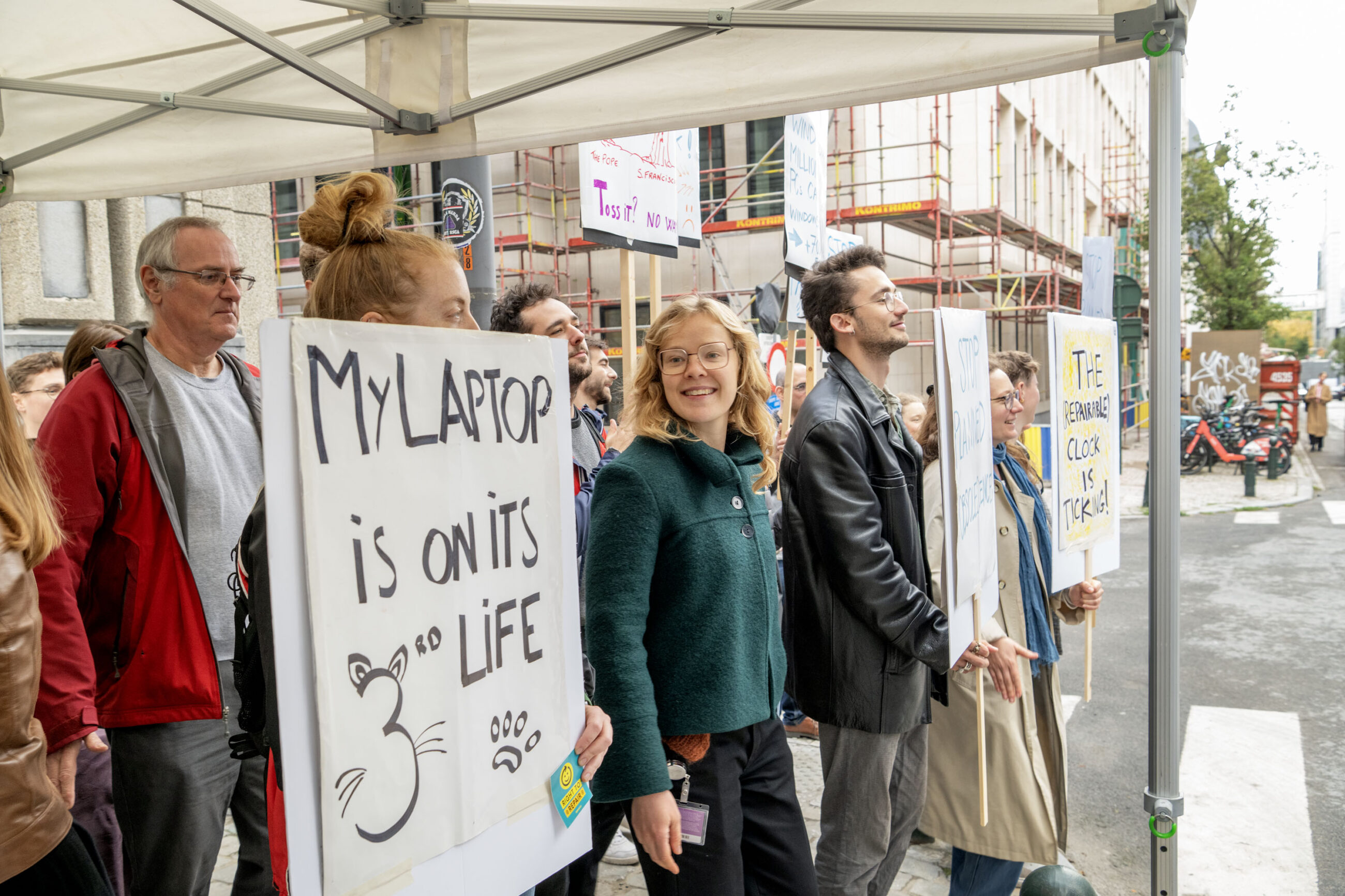
- We took on a tech giant and campaigned against the end of Windows 10, demanding that the European Commission also take action on software obsolescence
Ironically, Microsoft had planned on ending free and automatic support for Windows 10 on E-Waste Day and just four days before International Repair Day. The result would be ~400 million unsecure computers, potentially generating over 700 million kg of electrical waste. A disaster for sustainability and waste generation.
We rallied against this in a number of ways: through open-letters, spreading support for community organisations that wanted to help Windows users save their devices from the landfill, and through a mass-awareness campaign. And while we didn’t solve the issue of planned obsolescence, we still made major inroads. And we’ll push for more as part of the upcoming ecodesign legislation for computers.
- We proposed that it was essential for spare parts (and repairs) to be affordable in order for repairing to become the norm
Repair is, too often, far too expensive. Too expensive at least, for it to be possible for it to become the norm for the average person. So, consumers are pushed towards replacing a product rather than repairing it. So, we decided to do something about it.
Our coalition developed a proposal to address the high prices of original spare parts, through binding information requirements and the inclusion of price of spare parts in repairability scores. We believe that this would help consumers make informed decisions when purchasing products, and make sure they can actually repair these products when they break down.
Read more: Fixing the Unfair Reality of Spare Parts Prices