


By Claudia Bosch, Coordinator of Fair Electronics Campaign at SETEM Catalunya, member of Right to Repair Europe
Spain is currently transposing the European Right to Repair Directive through the Ley de Consumo Sostenible (Sustainable Consumption Law), led by the Ministry of Social Rights, Consumer Affairs and 2030 Agenda. Although the draft represents an important step forward, key issues, such as a clearer definition of what constitutes “reasonable repair prices” have yet to be addressed.
The Directive on common rules promoting the repair of goods (Directive (EU) 2024/1799 -commonly named as the Right to Repair Directive- that was passed last 2024, requires member States to have the transposition ready by 31 July 2026.
In Spain, this transposition has been led by the Ministry of Social Rights, Consumer Affairs and 2030 Agenda, and has been grouped up with the transposition of the Directive on Empowering Consumers for the Green Transition (Directive (EU) 2024/82). This combo will result in the future Ley de Consumo Sostenible (Sustainable Consumption Law) which for now is a draft law, that did not meet the transposition deadline of 31 of July 2026.
Different local organizations, some of them members of the Right to Repair Europe coalition, have been following this transposition very closely, in order to advocate for the integration of effective mechanisms to promote the right to repair, and make the most of the opportunities that the Directive opens to legislate in favour of better access to reparability criteria, spare parts, repair information, repair services, and making repair a more affordable option. We held a series of meetings with the Ministry since 2023, campaigned during the International Repair Day these last two years to push the demands forward, participated in the public consultation that opened during the summer of 2025, and held a final meeting last February 2026 in which we could discuss a second draft of the law.
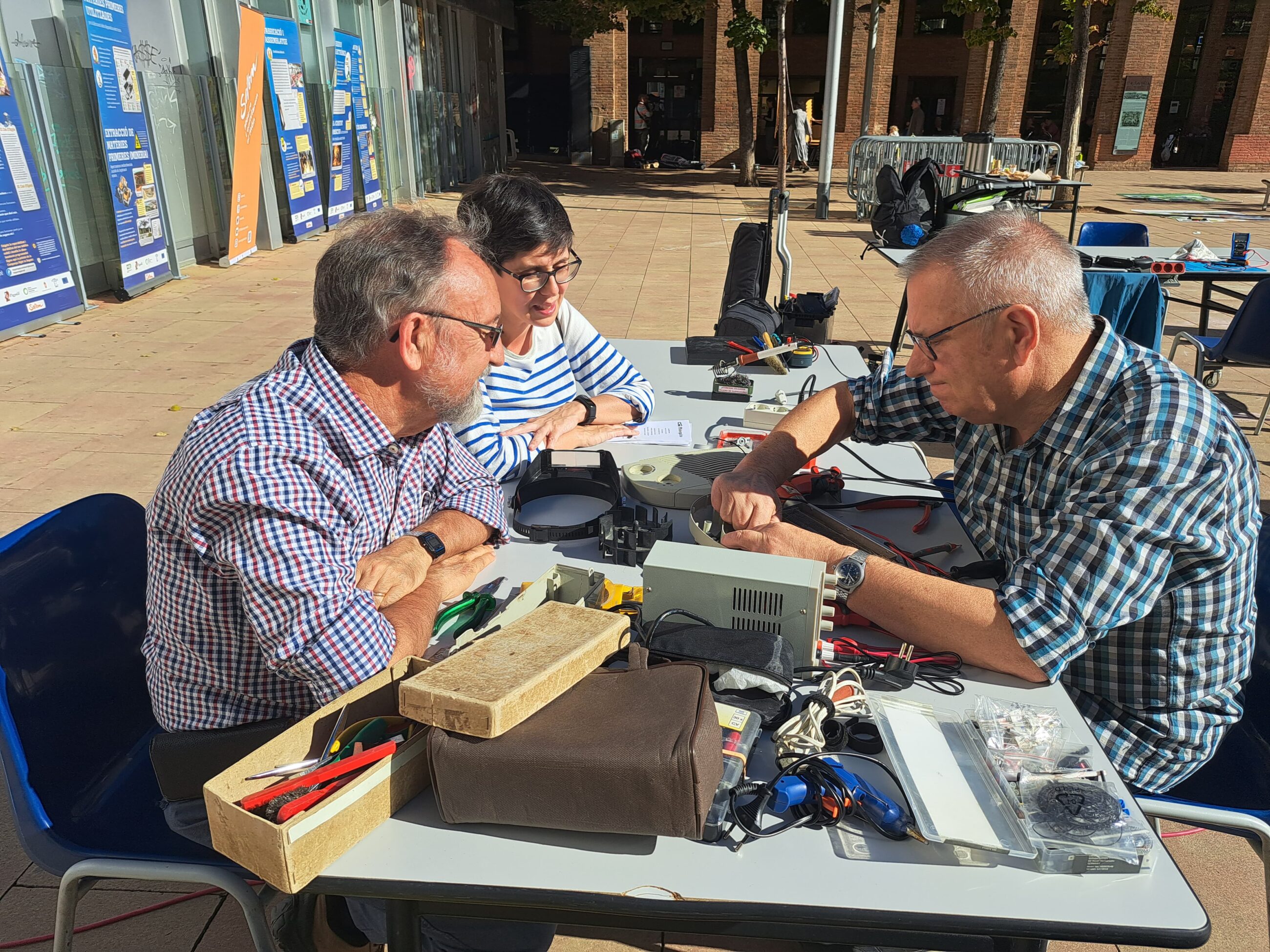
Repairers during International Repair Day in Barcelona, Spain in 2023
WINS AND LOSSES OF THE LAST DRAFT OF THE LAW REGARDING THE RIGHT TO REPAIR
Overall, the Ministry has been receptive to the demands put forward by civil society. However, some proposals have encountered resistance due to limitations imposed by other ministries, as well as concerns that an overly ambitious draft could risk its approval by the more conservative political forces in Parliament.
Below is a summary of the main highlights:
Unfair and misleading commercial practices
The criteria for determining whether a commercial practice is unfair because it is misleading will now also include the environmental characteristics of goods and services, in particular their circularity, durability, repairability and recyclability.
In addition, the draft introduces new practices that are expressly prohibited, all of them linked to the premature planned obsolescence of products (1).
More information and greater transparency for consumers
- On warranties: The draft law aims to clarify information on the legal guarantee of conformity and the commercial durability guarantee in order to avoid confusion among consumers. This will be achieved through an EU-wide harmonized label for the commercial guarantee, together with a harmonised notice on the legal guarantee of conformity.
- Information requirements for comparison services: Services that compare goods and services will be required to provide information on the comparison methodology, the goods and services being compared, and the providers of those goods and services, as well as the measures taken to keep this information up to date. This also includes comparisons relating to circularity aspects, such as durability, repairability and recyclability. These requirements will help protect consumers and prevent comparisons from being misleading or deceptive.
European Repair Information Form
Repairers may choose, on a voluntary basis, to use the free European Repair Information Form. The form will include the following information:
- The main characteristics of the repair service.
- The identity and contact details of the repairer.
- The price of the repair.
- The conditions under which the repair service will be provided and the expected timeframe for completion.
This will enable consumers to assess and compare different repair services. The measure aims to strengthen trust in repair services by ensuring that consumers receive clearer and more comprehensive information before deciding to proceed with a repair.
Repair before replacement
As established in the Directive, manufacturers will be required to offer consumers the option of repairing products free of charge or at a ‘reasonable price’, covered by the Right to Repair Directive within the legal warranty period. If the consumer chooses repair, the warranty will be extended by twelve months, providing an incentive to choose repair instead of replacement. The draft law has not included a clearer definition of what constitutes a ‘reasonable price’, neither of what constitutes a “reasonable price” for spare parts, despite our demands.
Something that the draft law does include is that refurbished products may be provided as replacement products while a repair is being carried out during the legal warranty period, and also when the consumer chooses replacement instead of repair.
Repair bonus
The draft law also includes one of civil society organisations’ main demands: a repair bonus, similar to the scheme already in place in France. The cost of repairs remains one of the main barriers to repair. This bonus is intended to encourage consumers to repair their products by reducing the cost of repair services.
The funding will be provided by producers themselves or, where applicable, by their authorised representatives, importers or distributors, either individually or collectively through Extended Producer Responsibility (EPR) schemes.
Although civil society organisations called for the same percentage of repair costs to be covered regardless of the age of the product, this proposal was not included in the draft. Instead, the draft establishes the following funding scheme:
a) During the first two years following the expiry of the legal guarantee of conformity or the relevant commercial warranty, the contribution towards repair costs will be 20%.
b) During the third year, the contribution towards repair costs will be 10%.
c) During the fourth year, the contribution towards repair costs will be 5%.
This scheme will only work for the products covered by the Right to Repair Directive. To benefit from this reduction, consumers will have to use a repair service registered on the European Online Repair Platform, which must verify that the repair is not required as a result of misuse of the product. Repairers will deduct this percentage directly from the repair price using the European Repair Information Form.
Repairers may subsequently claim reimbursement of this amount from the producers or, where applicable, from their authorised representatives, importers or distributors, who must reimburse the amount within a maximum of 30 days from the date of the request.
Producers will be required to publish annually the amounts allocated to financing repairs, the list of repair services to which these funds have been transferred, the number of products repaired, and the number of applications that have been rejected. This will provide valuable data to assess the impact of the repair bonus and to monitor the extent to which producers refuse to co-finance repairs, as well as the reasons for doing so.
Civil society organisations have also proposed introducing favourable fiscal measures, such as reducing VAT on second-hand and refurbished products. However, this proposal has not been included in the draft law because it was not supported by other ministries.
Online Repair Platform
Spain has opted to create a national section within the common interface of the European Online Repair Platform established under the Right to Repair Directive. This section will include not only repair services, but also retailers of refurbished products, businesses that purchase defective products for refurbishment, and community-based repair initiatives such as Repair Cafés. The inclusion of this wider range of actors was also one of the key demands put forward by civil society organisations. We believe this will help raise public awareness of these initiatives and, in turn, empower consumers by increasing their knowledge of repair.
NEXT STEPS
The latest draft is currently undergoing the TRIS procedure (Technical Regulation Information System) of the European Commission. This means there is still one final opportunity to take part in the public consultation, which will remain open until 15 September 2026, to reinforce support for the positive aspects of the draft law and to call for improvements to its weaker provisions. Once this process has concluded, the draft law will be submitted to the Spanish Parliament for its final vote.
It is decisive to continue putting pressure on the national governments that have not completed the transposition yet, to make the most of the opportunities that the Right to Repair Directive opens to make repair more accessible and affordable.
Looking forward to seeing you all in action on Repair Day 2026!
NOTES:
- These include:
- Hiding from consumers the fact that a software update may negatively affect the functioning of goods with digital elements or the use of digital content or digital services.
- Presenting a software update as necessary when it merely improves functionality and is not required to ensure the product remains in conformity.
- Making any commercial communication about a product that contains a feature designed to limit its durability, where the trader is aware of that feature and of its effects on the product’s lifespan.
- Falsely claiming that, under normal conditions of use, a product has a certain level of durability in terms of time or intensity of use, or presenting a product as unsuitable for reuse or the second-hand market when this is not the case.
- Presenting a product as repairable when it is not.
- Misleading consumers into believing that their products cannot be repaired because they have previously been repaired or inspected by an independent repairer or an end user, or by falsely claiming that such repair or inspection creates safety risks.
- Encouraging consumers to replace, refill or replenish consumable parts of a product earlier than is technically necessary.
- Concealing information about any deterioration in a product’s functionality resulting from the use of consumables, spare parts or accessories not supplied by the original manufacturer, or falsely claiming that such deterioration will occur.