


Tournevie, a member of the Right to Repair campaign, is the only tool library in Brussels. Thomas Opsomer, who represents iFixit in Right to Repair Europe’s steering group, also happens to be one of Tournevie’s founders. We visited him at the tool library to learn more about the work they do there and his role in including repairability as an indicator in the new product carbon footprint (PCF) for power tools.
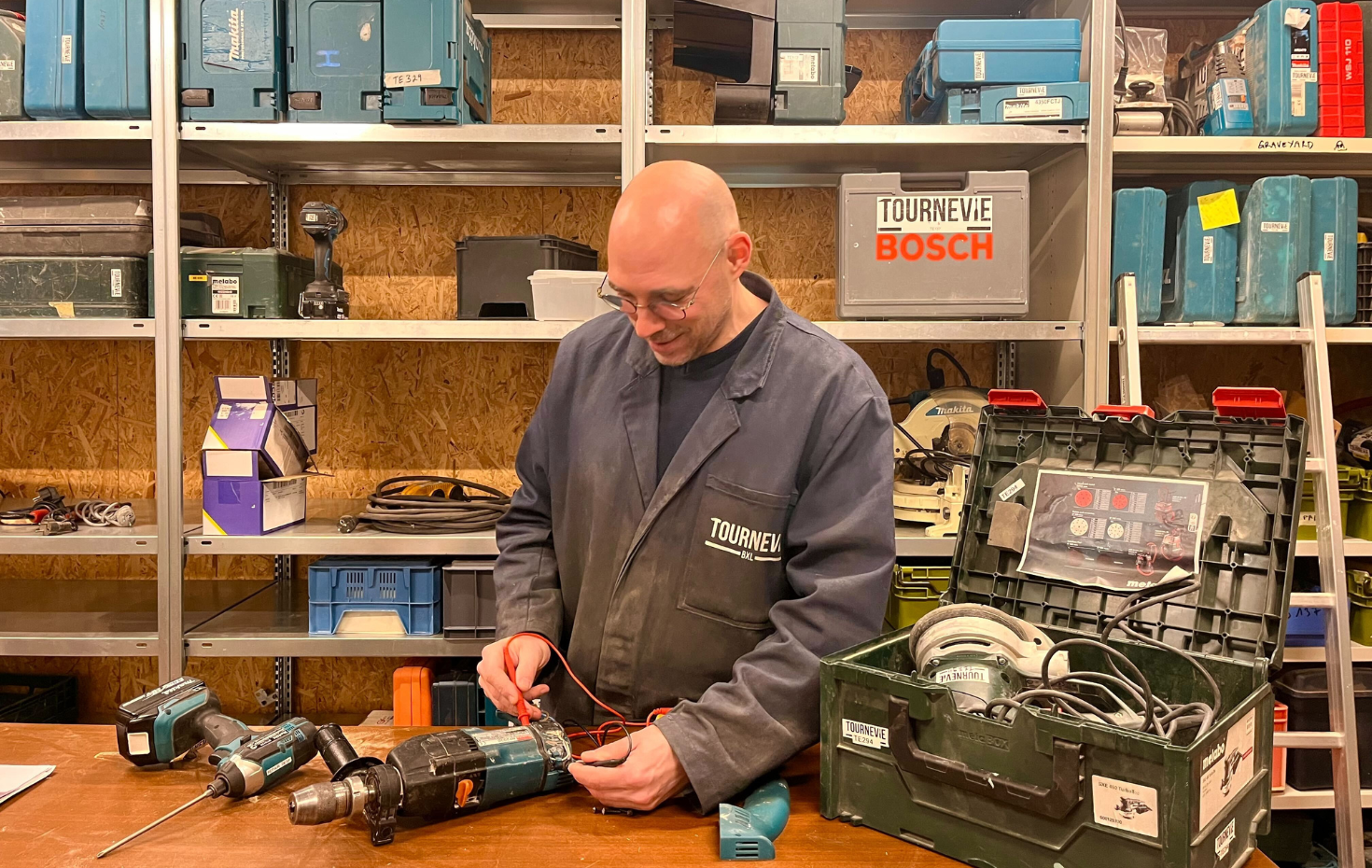
Hello Thomas, it’s great to have the opportunity to visit such a special place as Tournevie, can you tell us how it works?
Tournevie is a non-profit initiative run almost entirely by a group of dedicated volunteers for the last 10 years. It works just like a library for books but instead, you borrow electrical tools such as jigsaws or sanders and everything that you need for it, like the sandpaper or the saw blades. People pay an annual subscription and then get access to the complete collection, which is 500 plus power tools and a lot of hand tools. This is an affordable and environmentally friendly alternative to more expensive rental or sales outlets for repair or home renovation.
How did the project of Tournevie come to life?
Having worked for a professional power tool manufacturer, I grew very frustrated with the low quality of tools that are out there, which are cheap but then end up breaking easily and thrown away. I often had friends ask me for advice about which tool to buy and I would propose helping them find a good quality second hand tool instead of buying a cheap new one. Of course, that approach doesn’t scale. When I heard that a tool library had opened in Kortrijk, I thought that there really should be one in Brussels, but I wasn’t ready to start that project on my own. That was when I was contacted by Olivier who had the same idea, and we decided to embark on this journey together with some other volunteers.
So that’s a great way to reduce waste, but at the same time making tools more affordable for people, right?
Yes, definitely. Making access to quality tools affordable is at the core of our ideals. That’s why we want to keep the membership prices low, this way, anyone can benefit from it and find it more attractive than just buying a cheap tool for one use. We want to keep Tournevie open for everyone.
That’s really important. Coming back to the environmental impact of tools, can you tell me about this new product carbon footprint (PCF) standard that came out?
Yes, DIN SPEC 91519 is a technical rule telling you how to calculate the carbon footprint of a power tool by what is called a ‘functional unit’, that is, for instance, how many grams of CO2 does it take to drill a hole with a drill. Working on this was very important to me because precisely what we are doing with Tournevie is lowering the carbon footprint by giving people access to longer lasting tools.
It’s not that hard to measure the production footprint of an item or the amount of energy it uses. For me the most interesting part was to relate that to a lifetime. We know how many grams of CO2 are embedded in a circular saw. The question is, across how many cuts are you going to spread out that footprint? How do you define that?
And that is where the repairability of a tool comes in, right?
Exactly. The first element is what is called the ‘reference service life’, that is the average lifetime before the tool breaks down. This depends on the product quality. The second part is the ‘extended service life’, which is what you get from repair. The likelihood of that lifetime extension depends mostly on the economics of the repair. If the repair is too expensive, it’s unlikely to happen. The cheaper your spare parts are, the cheaper the repair is, the higher the lifetime extension factor that you can include in the footprint calculation. If there are no spare parts available, lifetime extension is not possible.
How was the process to get reparability and spare parts prices into the standard?
I’ve been working on objective criteria for evaluating reparability for about 10 years now, and I had already worked on EN 45554, which defines a general method for assessing repairability. I wanted to have some of these criteria factored into this new standard. Some of the manufacturers involved were already very aware of the reality of repair, because this process was initiated by some of the better brands who have repair in mind when they design their products, but they didn’t really know how to factor it in. And they definitely would not have thought of spare parts prices as an element in that. What I brought in from my experience with the Right to Repair campaign is precisely the importance of these spare parts prices, the research that we have showing that the likelihood of repair is directly linked to the cost of repair and therefore proposing for that to be factored into the lifetime extension formula.
Definitely, the affordability of repair is one of the key aspects of the work we do at the campaign. Now that the standard has been published, what does that mean concretely?
The standard is available free of charge and it can be used by manufacturers who want to indicate the carbon footprint of their tools. There wasn’t a harmonized method before, so there was no way that you would be able to compare the footprint of a drill by two different brands. Now you will be able to know which drill has a lower footprint per hole drilled. I think it’s also very relevant to say that it is the first standard of its kind that actually takes into account repair. There are already standards for calculating the footprint of products, but this is the first one that factors the lifetime extension through repair, based on the price of the spare parts, into the actual footprint of the product per unit of performance.
That’s such an important win for the Right to Repair campaign.
Yes! I think it’s a great precedent to make sure that future comparable standards will also take repairability into account.
Thanks for sharing this great news with us! To finish, how can people support Tournevie’s work?
First of all, you can support us by becoming a member and coming to borrow the tools instead of buying your own tools. And, if you have some time to spare, you can come give us a hand at the lending desk as a volunteer, especially if you have some DIY experience.
If you want to learn more about Tournevie, you can visit their website www.tournevie.be